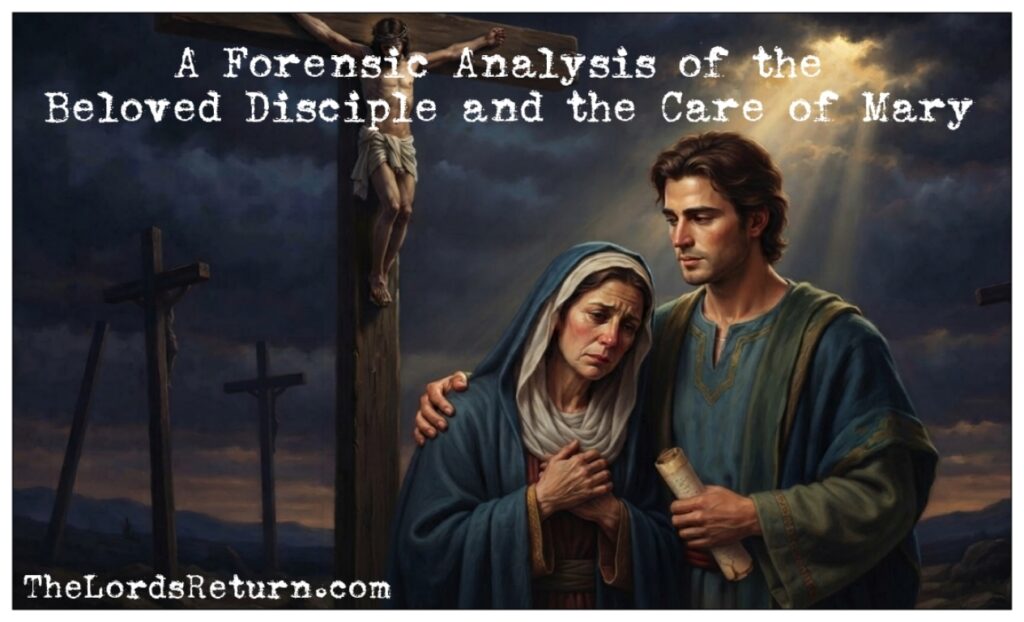
When modern culture looks at the Apostle John, it often frames him merely through the lens of sentimental art—a gentle, passive figure leaning on Jesus’ breast at the Last Supper or standing quietly at the foot of the cross. But the raw historical and scriptural record reveals a man of unyielding conviction, a “Son of Thunder” forged in the fires of divine truth, and a pillar of the early church whose life was entirely consumed by the defense of the Gospel. To understand the magnitude of the trust placed upon him at Calvary—where he was charged with the earthly care of Jesus’ mother, Mary—we must look beyond the soft portraits of tradition and examine the full breadth of men who bore the name John across scripture and history, and the profound theological weight of the moment.
In the ancient world, names carried weight, history, and prophetic significance. When examining the scriptural and historical record, the name John (derived from the Hebrew Yohanan, meaning “The LORD is gracious”) is borne by multiple pivotal figures whose lives intersect with the divine timeline of redemption.
- John the Baptist: The fiery forerunner of the Messiah, born of Zacharias and Elizabeth, who lived in the wilderness, wore camel’s hair, and rebuked the religious establishment with the ringing call: “Repent ye: for the kingdom of heaven is at hand” (Matthew 3:2, KJV). He compromised with no king, denounced sin without fear, and willingly decreased so that Christ might increase, ultimately sealing his testimony with his head on a charger.
- John the Apostle (The Son of Zebedee): A fisherman of Galilee who left his nets immediately at the call of the Master. Alongside his brother James, he was given the Aramaic surname Boanerges, which translates to “The Sons of Thunder” (Mark 3:17, KJV)—a title reflecting a fierce, zealous devotion to the truth that was eventually refined by the Holy Spirit into a profound, unshakeable love for the Savior and His doctrine.
- John Mark: The companion of Paul and Barnabas, and the author of the second Gospel. Though he stumbled early in his ministry by turning back from Pamphylia, he was later restored to usefulness, demonstrating the enduring mercy and reclamation found in service to the King.
- High Priest John (Jonathan) ben Annas: A prominent religious figure in the Book of Acts who stood in direct opposition to the early apostles, interrogating Peter and John and commanding them not to speak at all nor teach in the name of Jesus (Acts 4:6, 18).
While the high priests and worldly powers sought to silence the name of Jesus, it was John the Apostle—the Son of Thunder turned Apostle of Love—who stood unflinchingly where others fled.
The Scriptural Exhibit
The pivotal moment of transition at the cross is recorded with startling clarity in the Fourth Gospel. As the weight of the sins of the world rested upon Jesus, His biological brothers—who scripture notes did not yet believe in Him (John 7:5)—were absent from the scene, blinded by the carnal perspective of the age. Into that breach stepped John, the faithful disciple, standing shoulder-to-shoulder with the grief-stricken women at the foot of the execution stake.
John 19:26-27 (KJV):
“When Jesus therefore saw his mother, and the disciple standing by, whom he loved, he saith unto his mother, Woman, behold thy son! Then saith he to the disciple, Behold thy mother! And from that hour that disciple took her unto his own home.”
In this supreme moment of agony, Jesus did not look to earthly genealogy or biological bloodlines to fulfill the commandment to honor one’s parents. Instead, He established a new, eternal order—the household of faith. By charging John to treat Mary as his own mother, and by charging Mary to view John as her son, Jesus bound them together not by the fragile ties of the flesh, but by the unbreakable bond of shared spiritual devotion. John assumed full responsibility, taking her into his own home from that very hour, exactly as a faithful son must do.
The Forensic Analysis
Why was this duty assigned to John rather than Jesus’ own biological brothers? The answer lies in the fundamental nature of the Kingdom of God.
At the cross, the old covenant shadows were giving way to the reality of a spiritual family. Jesus’ brothers viewed His mission through a political and earthly lens, standing outside the inner circle of faith until after the resurrection transformed their hearts. John, however, stood as the representative of the faithful remnant. He was the one who leaned upon the Lord’s breast, who understood the deeper spiritual truths of the Word, and whose loyalty remained steadfast when the shadows deepened and the disciples scattered in fear.
By entrusting Mary to John, Jesus ensured two critical realities:
- Uncompromised Provision: Mary was provided for physically, morally, and spiritually within an environment of absolute fidelity to the truth.
- A Theological Anchor: The act solidified the truth that the true family of God is defined not by blood, but by those who do the will of His Father in Heaven.
John did not flinch from the cross, nor did he flinch from the lifelong duty entrusted to him there. He guarded Mary, just as he would later guard the doctrines of the faith against the early heresies that threatened to erode the Church.
The charge given to John at Calvary was far more than a simple act of domestic charity; it was a divine demonstration of the cost of discipleship and the reality of the family of God. While the world looked on in mockery and biological ties fractured under the pressure of persecution, true faith forged an eternal bond at the foot of the cross. John accepted the mantle, stepping forward when others drew back, and proving that the love of Christ demands our absolute, uncompromised allegiance.