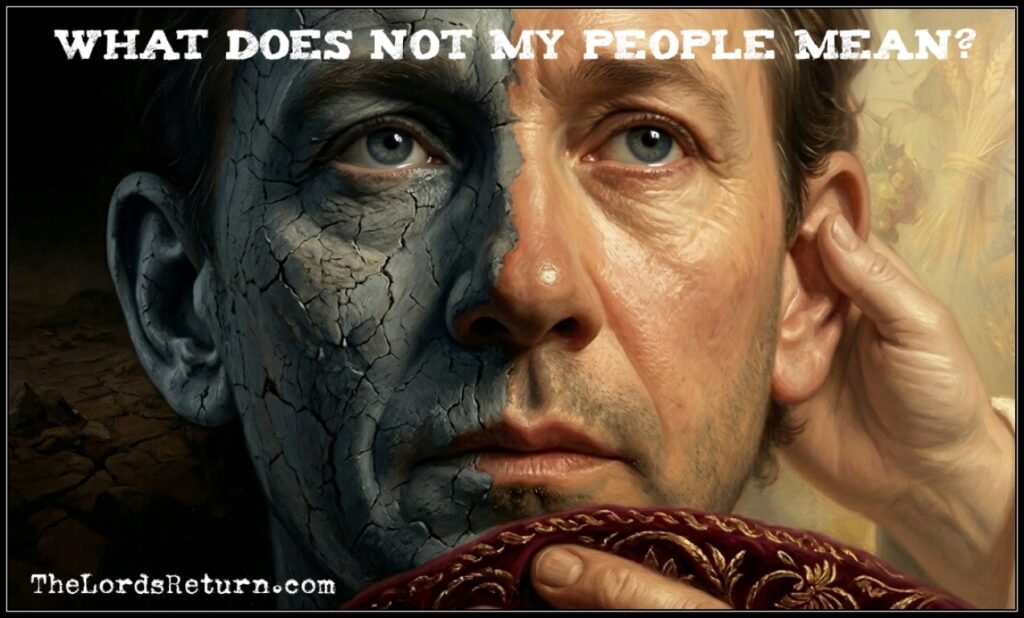
To understand the weight of the phrase “not my people,” we must look to a heartbreaking moment in Israel’s history when their persistent rebellion forced a holy God to issue a formal divorce decree to the nation. It is a phrase that marks the absolute limit of divine patience, yet it ultimately sets the stage for the most breathtaking display of sovereign grace ever recorded.
The phrase originates in the opening chapters of Hosea, where God commands the prophet to marry an unfaithful woman named Gomer as a living object lesson of Israel’s spiritual adultery. When Gomer gives birth to a third child, God gives the boy a name that must have struck terror into the hearts of the house of Israel:
“Then said God, Call his name Loammi: for ye are not my people, and I will not be your God.” (Hosea 1:9)
In Hebrew, Lo-Ammi translates directly as “not my people.” For generations, Israel’s entire security, identity, and existence rested on a single covenant promise: “And I will walk among you, and will be your God, and ye shall be my people” (Leviticus 26:12). By renaming them Lo-Ammi, God was tearing up the external privileges of that national contract. Because they had chosen to whored after false deities, adopted pagan customs, and treated His law as a strange thing, He explicitly cast them off into the wilderness of the Gentile nations.
Yet, this dark declaration was never intended to be the final word. In the very next breath, the Almighty reveals the forensic masterstroke of His redemptive plan—a mystery that would remain hidden for centuries until the coming of the Messiah. Immediately after pronouncing the sentence of Lo-Ammi, the text states:
“Yet the number of the children of Israel shall be as the sand of the sea, which cannot be measured nor numbered; and it shall come to pass, that in the place where it was said unto them, Ye are not my people, there it shall be said unto them, Ye are the sons of the living God.” (Hosea 1:10)
Centuries later, the Apostle Paul picks up this exact thread in the Book of Romans to solve a deep theological riddle: How can God legally bring the filthy, pagan, uncircumcised Gentile world into His holy family? Paul quotes Hosea directly, revealing that the phrase “not my people” was a prophetic doorway:
“As he saith also in Osee, I will call them my people, which were not my people; and her beloved, which was not beloved. And it shall come to pass, that in the place where it was said unto them, Ye are not my people; there shall they be called the children of the living God.” (Romans 9:25-26)
By reducing Israel to the status of Lo-Ammi (Gentile status) because of their sin, and by showing that God could and would sovereignly reclaim a people who were “not His people,” God leveled the ground for the entire world. The cross of Christ became the legal mechanism to undo the curse. Through the shed blood of Jesus, those who were alien, cast off, and utterly dead in trespasses—whether a backslidden Israelite or a pagan Gentile—are brought nigh.
When God uses the phrase “not my people,” He is demonstrating that relationship with Him is never a matter of mere lineage, national heritage, or dry ritual. It is a matter of uncompromised truth and faith. The phrase stands as a stark warning against cultural complacency and spiritual pride. But more importantly, it stands as a monument to a grace so deep that it searches out the outcast, the forgotten, and the utterly rejected, transforming those who were legally labeled “not my people” into the very sons and daughters of the living God.