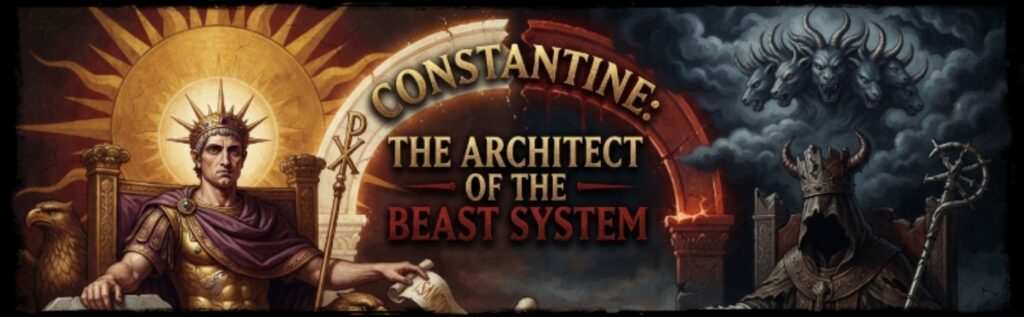
History bows in reverence to “Constantine the Great,” painting him as the noble champion who flung open the prison doors of the Roman Empire and rescued a bloodied church. But when the sanitized chronicles written by victors and state-historians are stripped away and measured strictly against the uncompromised measuring rod of Holy Scripture, a terrifying reality emerges.
Constantine did not convert to Christ; Christ was conquered by Rome. Through calculated political sorcery, syncretic devilry, and the stroke of a legislative pen, he executed the masterstroke of the adversary—merging the spotless bride of Christ with the harlot system of the pagan empire, and laying the structural foundation for the ultimate Antichrist power of the age.
The Devil’s Masterstroke: From Lions to Lures
For three hundred years, the satanic strategy against the church was brute force. Diocletian, Nero, and Decius fed believers to the beasts, burned them as torches in imperial gardens, and sought to drown the testimony of Jesus in a sea of martyr blood. Yet, the more the church was crushed, the more it multiplied. Tertullian’s eternal maxim held true: The blood of the martyrs is the seed of the church.
Satan realized a fundamental truth of spiritual warfare: persecution purifies, but compromise corrupts.
If the dragon could not destroy the church from without, he would seduce it from within. Enter Flavius Valerius Constantinus—a ruthless warlord, a murderer of his own family, and an unrepentant devotee of Sol Invictus (The Unconquered Sun). Constantine understood what the pagan emperors missed: you do not need to eradicate a faith if you can successfully absorb, co-opt, and invert it. By clothing the imperial throne in Christian vestments, he achieved what no Coliseum ever could. He disarmed the remnant not with the sword of execution, but with the poison cup of imperial favor, wealth, and worldly power.
This was the exact mechanism prophesied in Revelation 13—the dragon giving the beast “his power, and his seat, and great authority” (Revelation 13:2, KJV). The Roman Empire did not fall; it merely morphed into the ecclesiastical-political beast system, trading the naked paganism of the Caesars for the baptized paganism of a state-church machine.
The Abomination of Sol Invictus on the Throne
To call Constantine a Christian is blasphemy against the true faith. To his dying breath, his coins bore the image of the sun god. His triumphal arch in Rome dedicated his victory at the Milvian Bridge not to the blood of Jesus, but to the instinct of his own mind and the power of the divinity—a vague, syncretic deity that blended Christ with Apollo, Mithras, and Sol Invictus.
Constantine was a pragmatic politician who needed a unifying glue for a collapsing empire. Christianity was growing too fast to suppress, so he institutionalized it. But he did not bow to the Torah; he forced Christianity to bow to Rome.
He took the sacred worship of the Creator and polluted it with the Babylonian mysteries:
- He integrated pagan sun worship directly into the heartbeat of the church, cementing the worship of Dies Solis (Sunday) into law.
- He systematically drove the seventh-day Sabbath—the seal of the Creator’s covenant—underground, branding obedience to God’s immutable law as a capital crime.
- He traded the Passover of the Bible for Easter, a holiday steeped in fertility rites and anchored to the astrological cycles of the pagan calendar.
The Fulfillment of Prophecy: The Man of Sin and the Great Apostasy
The Apostle Paul warned the Thessalonians with absolute clarity that the day of Christ would not come except there first come a falling away, and that man of sin be revealed—the son of perdition, who opposeth and exalteth himself above all that is called God (2 Thessalonians 2:3–4). Daniel prophesied of a little horn power that would think to “change times and laws” (Daniel 7:25).
Who fulfilled this prophecy with greater precision than Constantine and the imperial church-state he spawned?
- He changed the Law: By legislating the first civil Sunday law on March 7, 321 AD, he presumed to alter the Sabbath of the Most High God, replacing the memorial of the Creator with the sacred day of the sun god.
- He changed the Times: By orchestrating the Council of Nicaea in 325 AD, he severed the church from its Hebrew foundations, outlawing the biblical calendar and fastening the community of believers to the rhythm of the Roman state.
When a secular tyrant sits in judgment over the assembly of the saints, enforces pagan sun worship by the edge of the civil sword, and marries the church to the political machinery of empire, he is operating in the exact spirit of Antichrist. He is the structural architect of the Great Harlot of Revelation 17—the system that sits upon many waters, with whom the kings of the earth have committed fornication.
Come Out of Her!
History looks back at Constantine with awe, singing the praises of the man who supposedly brought peace to the faith. But the true remnant—those who keep the commandments of God and have the testimony of Jesus Christ—look past the golden gloss of ecclesiastical history and see the chains.
Constantine did not save the church; he shackled it to the corpse of the Roman Empire. He traded the narrow, blood-sprinkled path of true discipleship for the broad, gilded highway of state-sanctioned compromise.
The call to every believer today is the same ancient, unyielding command issued to those trapped in the spiritual Babylon of old:
“And I heard another voice from heaven, saying, Come out of her, my people, that ye be not partakers of her sins, and that ye receive not of her plagues.” (Revelation 18:4)