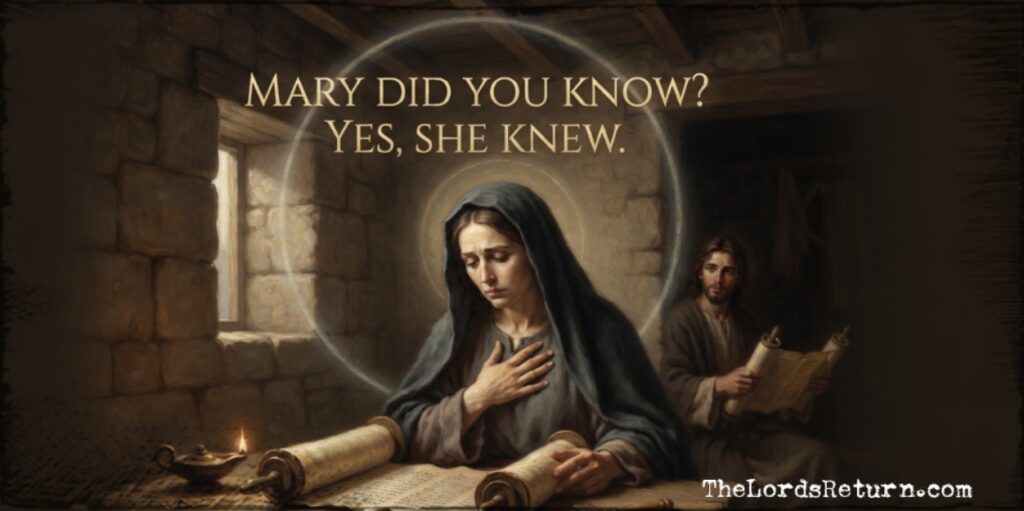
When modern melodies ask the haunting question, “Mary, did you know that your baby boy would one day walk on water, save our sons and daughters, or calm a storm with His hand?” the popular imagination often paints a picture of a bewildered, ordinary young girl stumbling blindly into a destiny she could scarcely comprehend. But when we lay the modern song against the bedrock of Scripture and the reality of a thirty-year life lived in the shadow of Nazareth, the answer is a resounding affirmation. Yes, she knew.
Long before the public ministry commenced, before the water turned to wine at Cana, and long before the agonizing darkness fell over Calvary, Mary of Nazareth held a divine blueprint within her heart. Her knowledge was not born of idle speculation or retroactive human wisdom; it was forged through direct angelic visitation, unwavering personal conviction, and decades of intimate communion with the living Word incarnate under her own roof.
To understand what Mary carried, we must return to the initial moment of conception, anchored by the immutable record of Luke 1:31–35, where the angel Gabriel declared to her:
“And, behold, thou shalt conceive in thy womb, and bring forth a son, and shalt call his name JESUS. He shall be great, and shall be called the Son of the Highest: and the Lord God shall give unto him the throne of his father David: And he shall reign over the house of Jacob for ever; and of his kingdom there shall be no end.”
There was no ambiguity in these words. She knew from the lips of a heavenly messenger that her child was not merely human, but the divine Son of the Highest, destined for an eternal throne. This profound realization echoed in her own song of praise, the Magnificat, where she declared in Luke 1:46–47 : “My soul doth magnify the Lord, And my spirit hath rejoiced in God my Saviour.” She knew her son was her Savior.
Beyond the initial angelic visitation, Mary’s mind was shaped by the scriptures and the unmistakable reality of living with the sinless Creator. In first-century Israel, where the Law and the Prophets were woven into the daily fabric of life through memory, synagogue teaching, and household instruction, Mary did not read the text as distant history. When she opened the scrolls, she was looking at a family ledger.
As any parent knows, children talk constantly about everything in the world. If Jesus was astounding the doctors of the law in the temple at twelve years old with a depth of understanding unmatched on earth, those conversations filled the home in Nazareth. He who authored the Scriptures explained them at His own family table. Mary listened to the living Word break down His own eternal mind in the everyday language of a growing boy. While the twelve disciples stumbled, argued over greatness, and remained entirely blind to the necessity of the cross until after the resurrection, Mary possessed a far deeper reservoir of understanding.
This comprehensive knowledge did not spare her from sorrow; rather, it gave her sorrow a sacred weight. In the temple during His infancy, Simeon looked upon the child and delivered a direct, piercing warning to Mary in Luke 2:34–35 :
“Behold, this child is set for the fall and rising again of many in Israel; and for a sign which shall be spoken against; (Yea, a sword shall pierce through thy own soul also,) that the thoughts of many hearts may be revealed.”
For thirty years, Mary lived under the shelter of divine protection. When Herod sought the young child’s life, God used dreams and miraculous warnings to direct Joseph, commanding them to flee into Egypt until the danger had passed. Heaven intervened; angels guarded their steps, and His hour had not yet come.
But Mary knew that protection had an expiration. Throughout His life, divine interventions preserved Him, yet she understood the ultimate trajectory of the scriptures she studied: the Shepherd must be smitten, and the Lamb must be slain.
When the darkness fell over Calvary, there would be no angelic warning sent to divert the blow, no midnight flight to Egypt, and no miraculous rescue. This was the very purpose for which He had entered the world. Even with all her foreknowledge—even knowing the graphic, agonizing details of the suffering He would endure—she stood by and watched it all unfold. There was no stepping in to shield Him, no way to save or protect Him this time. The shield was lowered so that the redemption of mankind could be accomplished, and in that awful, silent moment beneath the tree, the prophetic steel of Simeon’s warning drove deep, and the sword pierced entirely through her soul.