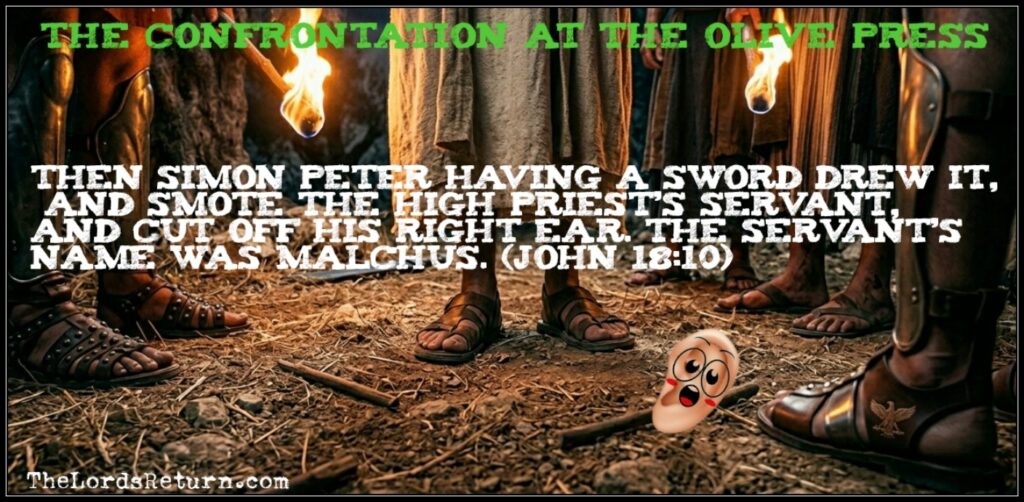
When the multitude descended upon the Mount of Olives with torches, lanterns, and weapons, they were led by a mixed force of Roman soldiers and Jewish authorities. Standing at the forefront of the religious delegation was Malchus. The Gospels explicitly identify him not as a common street guard, but as the doulos—the trusted personal agent, chief of staff, and direct representative—of Caiaphas the High Priest. Malchus wielded derived legal authority; he was the eyes, ears, and official signature of the prosecution.
Peter, operating on fierce loyalty and fleshly zeal, did not wait for commands. He drew a machaira—a heavy short sword or utility knife common among Galilean travelers—and struck.
“Then Simon Peter having a sword drew it, and smote the high priest’s servant, and cut off his right ear. The servant’s name was Malchus.” (John 18:10)
The Mechanics of the Strike
Peter was a commercial fisherman, not a Roman legionnaire trained in formal swordsmanship. When violence erupted in the dark, he fell back on raw muscle memory and the frantic instinct of a man used to handling heavy blades for cutting ropes and gutting fish.
The trajectory of the wound tells the story of the struggle. For a right-handed swordsman facing an opponent head-on, a standard downward chop naturally lands on the victim’s left side. Yet, the text explicitly specifies that Malchus lost his right ear.
This indicates one of two high-speed physical realities:
- The Reflexive Twist: Peter aimed a lethal, vertical blow at Malchus’s head or neck. Seeing the steel coming, Malchus violently ducked and twisted his body to his left to escape the blade. By pulling his left side back, his right ear was rotated directly into the path of Peter’s descending sword.
- The Drawing Arc: As a right-handed man drawing a blade from a scabbard on his left hip, Peter’s most natural, fluid movement under panic would be a sweeping, cross-body draw from left to right. This upward, horizontal arc would slice cleanly across the right side of an opponent standing directly in front of him.
Peter was not attempting to clip an ear; he was swinging for the neck. Malchus narrowly saved his own life by an inch of movement, leaving his severed ear on the dirt of Gethsemane.
Erasing the Evidence of a Capital Offense
By wounding the High Priest’s personal representative during an official state arrest, Peter had committed an act of violent insurrection against the Judean authorities. Under both Roman and Jewish law, this was a capital offense. Had the evidence remained, Peter would have been arrested on the spot, bound alongside Jesus, and subjected to immediate execution.
Furthermore, ancient Levitical law dictated that any man with a physical blemish or mutilation was disqualified from serving within the inner temple precincts or holding high holy offices. Peter’s strike had effectively ruined Malchus’s career, status, and livelihood.
It is against this backdrop of legal jeopardy and imminent bloodbath that Christ intervened.
“And Jesus answered and said, Suffer ye thus far. And he touched his ear, and healed him.” (Luke 22:51)
With a single compassionate touch, Jesus performed His final miracle before the cross. It was an act of profound strategic restraint. By restoring Malchus’s ear, Jesus did not just heal a physical wound; He completely erased the corpus delicti—the physical evidence of Peter’s capital crime.
When the guards looked down, the blood was there, but the ear was whole. There was no longer a legal basis to arrest Peter as a violent rebel. Jesus quietly undid the damage caused by His disciple’s reckless zeal, protecting the inner circle from execution, protecting Malchus from permanent disfigurement, and ensuring that He alone would drink the cup of the Father’s wrath that night.