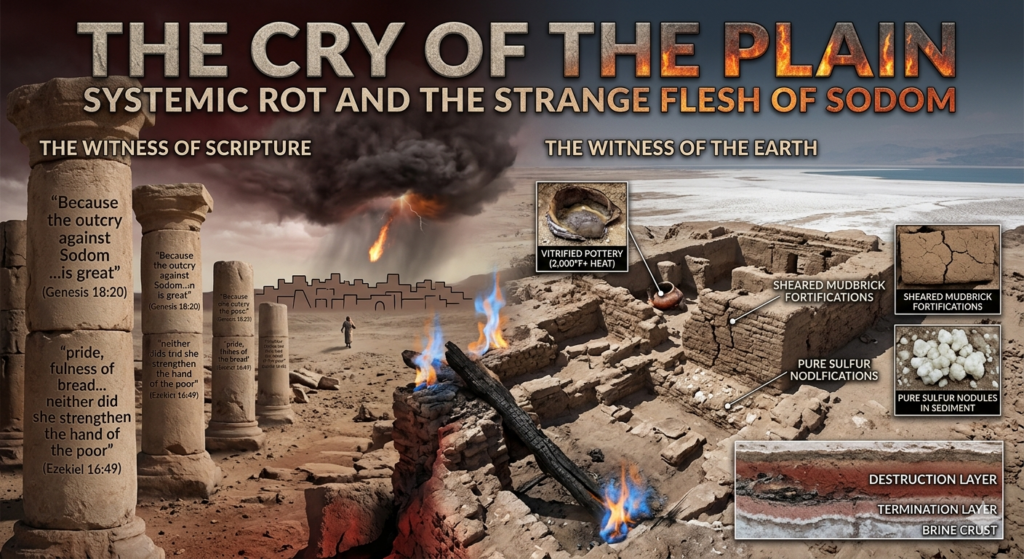
To truly understand the catastrophic judgment that befell Sodom and Gomorrah, we must look through the infallible witness of Scripture and the tangible scars left in the earth. The historic account is not merely a tale of sudden fire; it is a blueprint of divine patience exhausted by systemic, unrepentant wickedness. The Bible explicitly states that God did not act without a full and just examination. In Genesis, the Lord establishes the baseline for the impending judgment, declaring, “Because the outcry against Sodom and Gomorrah is great, and because their sin is very grave; I will go down now, and see whether they have done altogether according to the outcry of it, which is come unto me; and if not, I will know” (Genesis 18:20-21). This outcry represents the groans of the oppressed, the victims of a society that had completely inverted morality. While the culture today often focuses entirely on one aspect of their transgression, the Prophet Ezekiel provides a forensic breakdown of the structural rot that brought the fire, revealing, “Behold, this was the iniquity of thy sister Sodom, pride, fulness of bread, and abundance of idleness was in her and in her daughters, neither did she strengthen the hand of the poor and needy. And they were haughty, and committed abomination before me: therefore I took them away as I saw good” (Ezekiel 16:49-50). The physical abomination was the final fruit of a root system built on pride, total disregard for human dignity, violent inhospitality, and an utter lack of the fear of God. They had reached a point of no return where even the presence of holy angels prompted an aggressive mob outbreak.
We know with absolute certainty that their dark evils culminated in flagrant sexual sin because the biblical text uses highly specific, unmistakable Hebrew and Greek terminology to describe these events. When the mob surrounded Lot’s house, they demanded, “Where are the men which came in to thee this night? bring them out unto us, that we may know them” (Genesis 19:5). The Hebrew word used here for “know” is yada. While it can mean simple acquaintance, it is the standard, formal Hebrew euphemism used throughout the Old Testament for intimate carnal relations. This intent is verified beyond doubt by Lot’s frantic response, “Behold now, I have two daughters which have not known man; let me, I pray you, bring them out unto us, and do ye to them as is good in your eyes: only unto these men do nothing” (Genesis 19:8). Lot uses the exact same Hebrew root to describe his daughters’ virginity. If the mob outside merely wanted to check travel credentials, Lot’s counter-offer makes no logical sense; it functions purely as a desperate negotiation to prevent a violent, collective sexual assault. The New Testament writers, fluent in the historical weight of the text, explicitly define this transgression using precise Greek terms. The Apostle Jude writes that Sodom and Gomorrah, “giving themselves over to fornication, and going after strange flesh, are set forth for an example, suffering the vengeance of eternal fire” (Jude 1:7). The word for fornication, ekporneuō, denotes extreme, unrestrained sexual immorality, while “strange flesh”—heteras sarkos—signifies a complete departure from the divinely ordained order of human sexuality, involving the pursuit of relations that violate natural boundaries. The Apostle Peter reinforces this by describing how righteous Lot was “vexed with the filthy conversation of the wicked” (2 Peter 2:7), where “filthy conversation” derives from aselgeia, meaning unbridled lust and shameless excess.
For centuries, skeptics treated the “brimstone and fire” as pure allegory, yet modern archaeology has uncovered chilling physical data that matches the Genesis record with terrifying precision. At the leading candidates for the ancient Cities of the Plain, excavators have uncovered an abrupt, city-wide termination layer that defies standard military destruction. Pottery sherds have been recovered with outer surfaces melted completely into glass, a process of vitrification that requires brief exposure to temperatures exceeding 2,000 to 3,000 degrees Fahrenheit, perfectly mirroring a sudden, intense furnace-like heat falling from above. Massive mudbrick fortifications over 40 feet thick were instantaneously sheared off at their foundations, with the debris blown in a uniform direction. Furthermore, the surrounding geography of the Dead Sea basin contains a phenomenon found nowhere else on earth: millions of independent, white sulfur nodules embedded in the sedimentary cliffs. Testing reveals these are 95% to 98% pure sulfur, unlike yellowish volcanic sulfur, and they burn with an intense, blue, suffocating flame that leaves a melted, scorched capsule in the stone. The entire region, once described as “even as the garden of the Lord” (Genesis 13:10), was suddenly blanketed in a high-concentration brine crust, rendering the soil completely sterile and uninhabited for over six centuries.
The prophets and apostles constantly bring up Sodom as a standardized yardstick for spiritual blindness and impending judgment. Moses warned that covenant breaking would lead to a land of brimstone and salt, “like the overthrow of Sodom, and Gomorrah” (Deuteronomy 29:23). Isaiah addressed the corrupt politicians of his day directly, crying, “Hear the word of the Lord, ye rulers of Sodom; give ear unto the law of our God, ye people of Gomorrah” (Isaiah 1:10), noting that they “declare their sin as Sodom, they hide it not” (Isaiah 3:9). Jeremiah and Zephaniah predicted the total, irreversible fall of Babylon, Edom, Moab, and Ammon by comparing their final desolation to the ash of the plain. In the New Testament, Jesus Himself used the historical reality of the city to warn those who reject the gospel message, declaring, “It shall be more tolerable for the land of Sodom and Gomorrah in the day of judgment, than for that city” (Matthew 10:15, KJV). He cautioned that the final days of this age would mirror the days of Lot, when “they did eat, they drank, they bought, they sold, they planted, they builded; But the same day that Lot went out of Sodom it rained fire and brimstone from heaven, and destroyed them all” (Luke 17:28-29, KJV). The ash, the vitrified clay, and the pure sulfur remain embedded in the dirt today as a permanent billboard for humanity, proving that when a society institutionalizes pride and casts off all natural sexual restraint, the Truth always leaves a physical record.