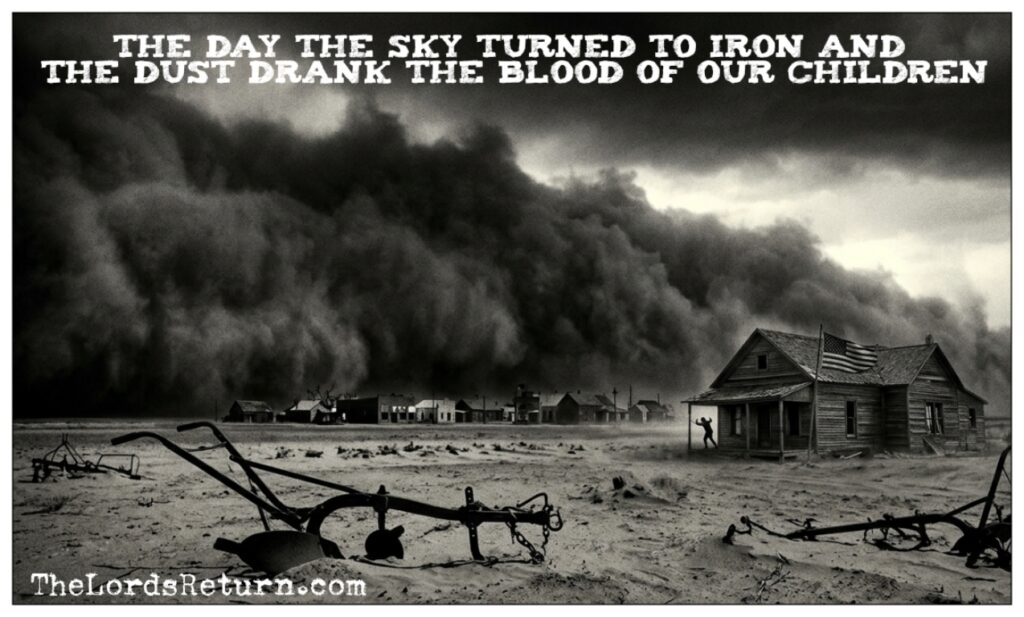
The fields of the southern plains were never meant to be turned into a mechanized factory, yet in the opening decades of the twentieth century, man looked upon the vast, deep-rooted prairie grasses of the American wilderness and saw only an opportunity to enrich himself. Driven by an arrogant, unscriptural philosophy that declared “rain follows the plow,” thousands of eager settlers and heavy farming syndicates descended upon the land with massive iron tractors, tearing up millions of acres of native sod that had held the moisture of the earth together since the dawn of creation. They genuinely believed that by their own hand, through the sheer force of human industry and technological might, they could alter the very climate, command the clouds to drop their fatness, and force the soil to yield endless wealth. They forgot the foundational reality that the earth belongs to the Creator, and that it is He alone who stayeth the bottles of heaven. When men attempt to strip the earth of the protective covering God designed for it, they strip away their own protection, inviting a swift and devastating recompense. “Be not deceived; God is not mocked: for whatsoever a man soweth, that shall he also reap.” (Galatians 6:7).
The American Dust Bowl wasn’t an environmental accident—it was a violent, drug-fueled binging on greed where modern man took a razor blade to the throat of the created order. In the early 1900s, armed with a blinding, demonic hubris, armies of speculators marched onto the Great Plains. They looked at millions of acres of ancient, deep-rooted prairie grasses—a magnificent, living carpet perfectly engineered by the Almighty to hold the soil together through centuries of cycles—and they saw a carcass to be stripped. They mocked the balance of nature. They actually peddled a scientifically illiterate, arrogant heresy, telling themselves that by cutting open the belly of the earth, human industry would magically force the windows of heaven to open. They raped the topsoil, tearing out the roots, leaving the earth raw, naked, and bleeding across a geographical expanse the size of empires. They wanted wheat, they wanted cash, and they wanted it now. They treated the footstool of the Most High like a mechanical vending machine. “He turned rivers into a wilderness, and the watersprings into dry ground; A fruitful land into barrenness, for the wickedness of them that dwell therein.” (Psalm 107:33-34).
And then, the Almighty turned off the rain.
What followed is the closest this continent has ever come to a literal, living hell, and man engineered every single inch of it. By 1931, the wet years inevitably came to an end, and the proud illusion of human mastery vanished like a vapor. As a severe, entirely natural drought settled over the region, the horrific cost of man’s geographic tampering became plain for all to see. With the deep, native root systems completely obliterated by the plow, the exposed topsoil disintegrated into a fine, black powder. The wind caught it, and it didn’t just blow—it mutated into apocalyptic, rolling mountains of suffocating black fury that rose 10,000 feet into the stratosphere. These “Black Blizzards” traveled at sixty miles an hour, blotting out the midday sun so completely that men could not see their own hands directly in front of their faces at noon. The horror inside the homes was psychological torture. The static electricity generated by these monstrous dust storms was so highly charged that it would short out car engines, knock grown men flat on their backs if they shook hands, and ignite blue sparks of fire along the barbed-wire fences. People slept with wet sheets over their faces, only to wake up coughing up black mud, their eyes sealed shut by grime.
The dust didn’t care about walls or locks. It invaded every lung, every crib, and every kitchen. It choked the cattle until their stomachs were found literally packed tight with solid balls of dirt. It killed the children. A horrific epidemic called dust pneumonia swept through the plains, literally cementing the lungs of infants with the very dirt their fathers had greedily plowed up. Parents sat in the pitch blackness, listening to their children gasp and suffocate on the air of their own homesteads. It was a literal, physical manifestation of the curse of disobedience playing out in real-time on the American stage. “And thy heaven that is over thy head shall be brass, and the earth that is under thee shall be iron. The Lord shall make the rain of thy land powder and dust: from heaven shall it come down upon thee, until thou be destroyed.” (Deuteronomy 28:23-24).
The pride of human machinery was utterly crushed. Tractors were buried to their rooftops in shifting dunes of dead earth. Millions of tons of what used to be a fertile American breadbasket were lifted into the sky and carried across the continent, dumping black grit onto the desks of politicians in Washington D.C., and staining the snows of New England a dirty, sickening brown before venting out into the Atlantic Ocean. The land literally vomited out over two hundred thousand people, sending them fleeing down the highways like war refugees, destitute, broken, and starved. Man thought he could master the climate and bend the soil to his pocketbook, and the Creator answered by letting the wind blow man’s kingdom right out into the sea. “He that trusteth in his own heart is a fool…” (Proverbs 28:26).
This catastrophic failure stands as an undeniable, historical monument to the absolute futility of human hubris. Modern secular textbooks treat the Dust Bowl as a mere economic mishap or a run of bad weather, refusing to acknowledge the deeper spiritual law at work. They cannot see that when humanity steps outside the boundaries of the created order to force its own selfish will upon the planet, the complex machinery of creation will always snap back with terrifying, crushing force. The ruined, skeletal remains of abandoned farmsteads buried beneath mounds of shifting sand are a stark, silent witness to what happens when dust tries to war against the Almighty. Man is not the master of the wind, nor is he the sovereign ruler of the soil; he is merely a tenant living on borrowed time, completely dependent on the mercy of the One who weighs the hills in a balance. “Go to now, ye that say, To day or to morrow we will go into such a city, and continue there a year, and buy and sell, and get gain: Whereas ye know not what shall be on the morrow. For what is your life? It is even a vapour, that appeareth for a little time, and then vanisheth away.” (James 4:13-14).