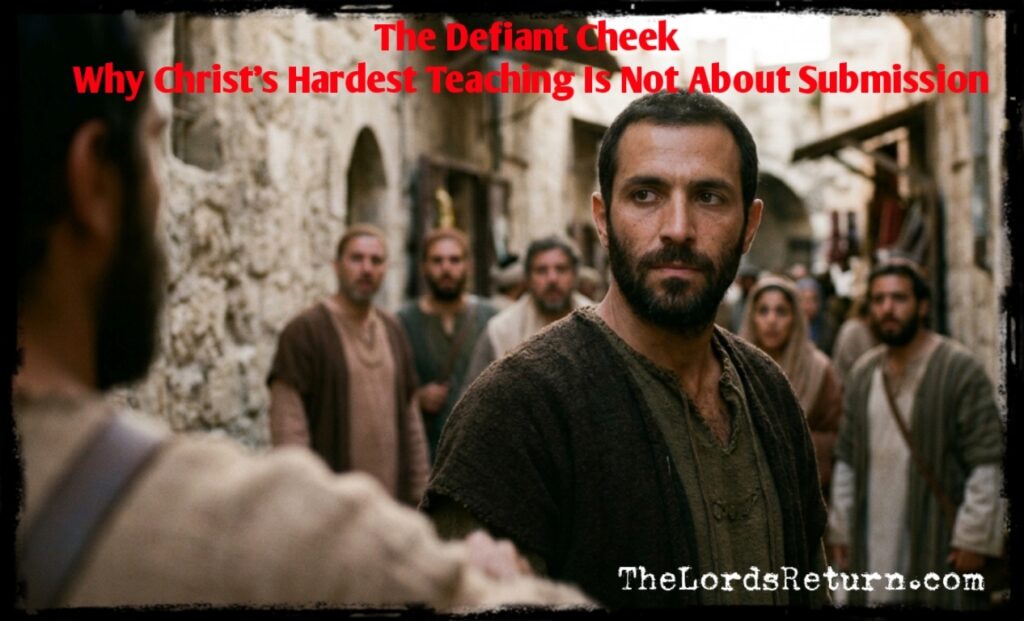
The phrase “turn the other cheek” is perhaps the most widely misunderstood mandate in the entire text of Scripture. In modern cultural vernacular, it has been diluted into a doctrine of passive surrender—a sort of spiritualized doormat philosophy that requires a believer to quietly accept abuse, bow to injustice, and endure humiliation without a word. The world looks at this caricature and calls it cowardice; many in the church look at it and call it piety. Both are entirely wrong.
When we look at the actual text through a precise, historical lens, the true meaning is far from passive. It is a brilliant, defiant statement of personal dignity, absolute composure, and unyielding conviction. It was never a command to suffer unchecked destruction, but rather a masterful strategy for standing fast against the pressure of a hostile world.
“But I say unto you, That ye resist not evil: but whosoever shall smite thee on thy right cheek, turn to him the other also.” (Matthew 5:39)
To unlock the mechanics of this statement, one must look at the physical reality of what is being described. Christ specifies the right cheek. If a right-handed person—the standard cultural assumption of the ancient Near East—strikes someone on the right cheek, how must they hit them? They cannot use an open palm or a closed fist without an incredibly awkward maneuvering of the arm. To strike someone’s right cheek with your right hand, you must strike them with the back of your hand.
Under Roman occupation, a backhanded slap was a very specific, calculated gesture. It was not an attempt to start a physical brawl; it was a demonstration of superior status. It was how a master struck a slave, a Roman soldier struck a subject, or an elite struck a peasant. It was designed to humiliate, to demand submission, and to remind the victim of their lower social standing.
Now, consider the tactical response Christ commands: “turn to him the other also.”
If you turn your left cheek to the aggressor, you alter the entire dynamic of the confrontation. They can no longer backhand you. To strike your left cheek with their right hand, they are forced to use an open palm or a closed fist. In that culture, an open-palm strike or a punch was a blow delivered only between equals.
By turning the other cheek, you are not saying, “Please beat me up.” You are saying, “You will not strip me of my dignity. You will not treat me as an inferior. If you want to strike me again, you will have to look me in the eye and hit me as an equal.” It is a profound declaration of spiritual sovereignty. You refuse to lower yourself to their level of malice, yet you refuse to validate their claim of superiority over you.
But what happens if the aggressor actually strikes again? Does a believer simply stand there as a perpetual human punching bag?
Scripture never commands a believer to absorb endless physical destruction in silence. We see the perfect model of this teaching when Christ Himself was struck across the face by an officer during His trial before the high priest. He did not passively look at the floor, nor did He throw a punch back. Instead, He deployed a sharp verbal defense of the truth: “Jesus answered him, If I have spoken evil, bear witness of the evil: but if well, why smitest thou me?” (John 18:23, KJV). The scriptural response to repeated malice is to expose the lawlessness and injustice of the aggressor, bringing their hidden wickedness completely into the light.
Furthermore, when an insult escalates into an inescapable threat to life, the biblical framework shifts entirely from enduring an insult to the absolute duty of protection and defense. There is a massive theological and practical line between a slap on the cheek and a deadly assault.
Scripture explicitly recognizes the right to use force to stop violent, lawless ruin. In the framework of God’s law, the right to protect one’s home and family against a lethal threat is clearly established: “If a thief be found breaking up, and be smitten that he die, there shall no blood be shed for him.” (Exodus 22:2).
While Christ told His disciples to walk peaceably, He radically updated their tactical instructions on the very night He was betrayed, knowing the cultural landscape was turning violently hostile: “Then said he unto them, But now, he that hath a purse, let him take it, and likewise his scrip: and he that hath no sword, let him sell his garment, and buy one.” (Luke 22:36). A sword was a weapon of lethal force, meant for self-preservation and the restraint of evil on perilous roads. To stand by and watch a family member or an innocent neighbor be brutally destroyed when you have the physical capability to step in is a failure of the biblical duty to love and protect.
The cheek is for insults, social slurs, and humiliation; the sword is for the defense of life when escape is impossible. Turning the other cheek does not mean laying down your identity or your safety to be trampled by the wicked. It means standing so firmly rooted in the truth that no insult can shake your composure, while recognizing that your life—and the lives of those entrusted to your care—are sacred gifts worth defending. We are called to overcome evil, never to be broken by it, standing fast in the knowledge that the King is at the door.