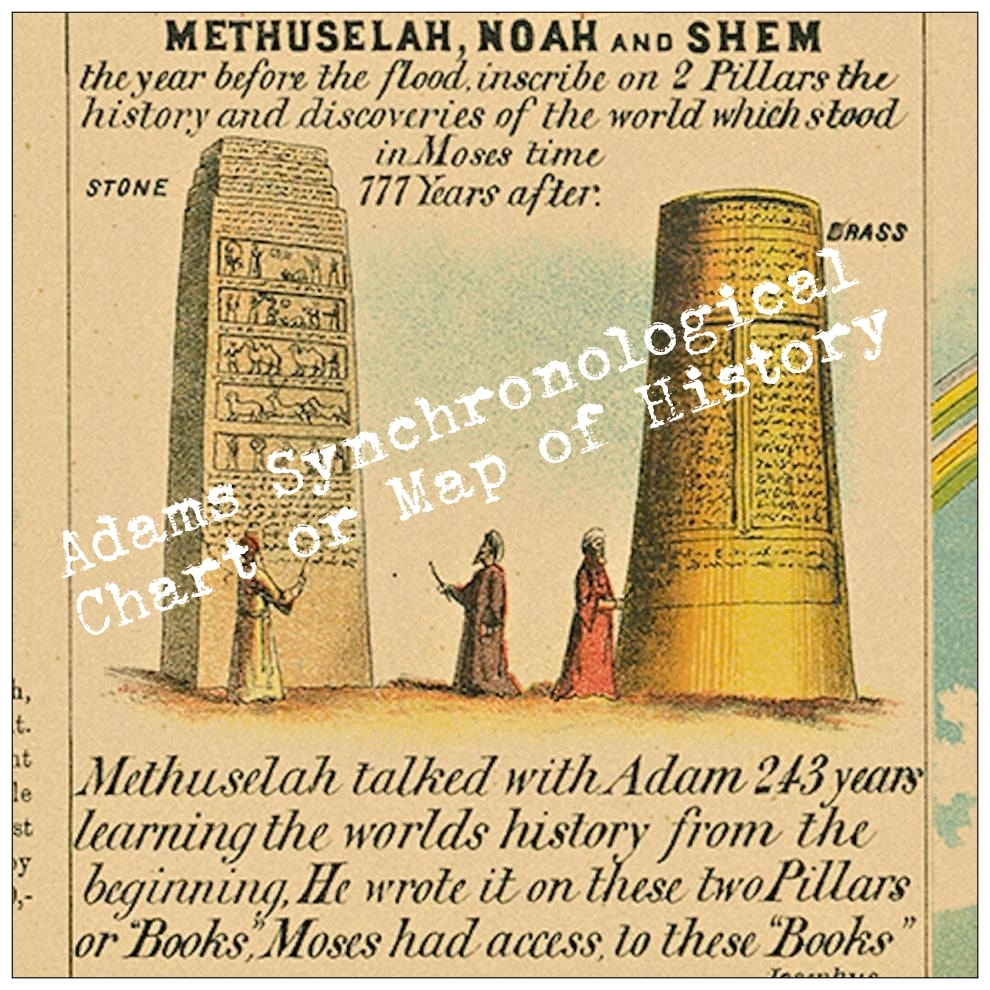
Within the realm of historical investigation, few enigmas command the imagination like the legend of the Antediluvian Pillars. According to ancient tradition, two monumental columns—one of brick and one of stone—were erected before the Great Deluge to act as an indestructible archive, preserving the foundational sciences of early humanity across a universal cataclysm.
Depending on the source material, the construction of these pillars is attributed either to the righteous line of Seth (specifically Enoch) or to the industrious line of Cain (specifically Tubal-cain and his siblings). However, a meticulous forensic, chronological, and theological audit of the ancient world raises a fundamental question that challenges the very core of the legend: Did these physical pillars ever exist at all, or were they always a symbolic metaphor for human transmission?
If a physical monument had been built before the Flood, it would have been utterly ground to dust by the cataclysmic forces of the Deluge. What ancient historians later documented as “pre-Flood” artifacts were either massive, early post-Flood reproductions engineered by the immediate descendants of Noah, or an allegorical misunderstanding of history itself.
The Origin of the Tradition
The earliest and most prominent historical recording of this tradition comes from the first-century Jewish historian Flavius Josephus in his Antiquities of the Jews (Book 1, Chapter 2). Josephus attributes the pillars to the grandchildren of Adam through his son Seth, noting that they were masters of astronomy and celestial mechanics. Having been warned by Adam of an impending global destruction by water and fire, they took defensive action:
“They also that they might not lose the discovery of these sciences, nor let them perish before they were known… made two pillars; the one of brick, the other of stone: they inscribed their discoveries on them both, that in case the pillar of brick should be demolished by the flood, the pillar of stone might remain, and exhibit those discoveries to mankind…”
— Flavius Josephus, Antiquities 1.2.3
Josephus goes on to make a startling geographic claim for his day, asserting that the stone pillar was still standing in his own time in a land called “Siriad.”
Conversely, a parallel medieval and Renaissance craft tradition—preserved in the Old Charges of Freemasonry—attributes the exact same twin pillars to the children of the Cainite Lamech: Jabal, Jubal, Tubal-cain, and Naamah. In this version, the siblings huddled together to engrave their respective breakthroughs in agriculture, music, metallurgy, and textiles onto brick and stone to protect their human legacy from the coming wrath.
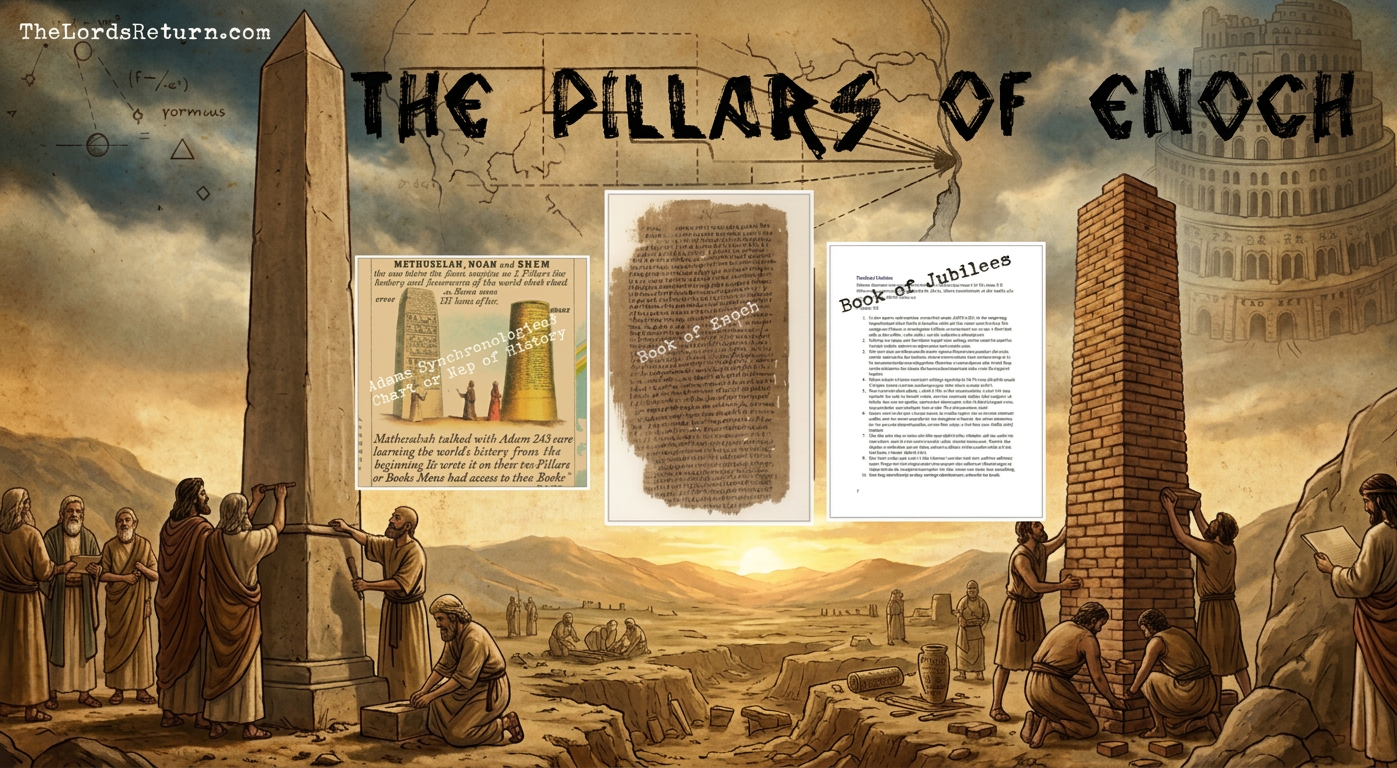
The Primary Question: Were They Ever Real?
Before tracing the physical path of these monuments, the investigator must confront the very real possibility that the “Pillars” were never physical structures of stone or clay. In the ancient Near East, the term “pillar” was frequently employed as a literary and theological metaphor rather than a description of literal masonry.
1. The Pillar as human Custodians
In ancient Hebrew and Mediterranean thought, a “pillar” ($\text{עַמּוּד}$) was a metaphor for a foundational person, a guardian of truth, or a lineage that holds up a community. The Apostle Paul utilized this exact phrasing when he referred to James, Cephas, and John as men “who seemed to be pillars” (Galatians 2:9).
The original antediluvian “pillars” may have been the two distinct lineages themselves: the Line of Seth (holding up the spiritual archive of astronomy and the knowledge of the True God) and the Line of Cain (holding up the material archive of metallurgy and industrial craft). When the oral traditions traveled across the centuries, later Greek, Roman, and medieval writers—accustomed to monumental architecture—fused the metaphorical “pillars of humanity” into physical columns of stone and brick.
2. The Language of the Core Archive
Forensically, if a physical monument truly dated back to the antediluvian world, its inscriptions would not—and could not—be written in Hebrew, Greek, or classical Egyptian hieroglyphs. All of these linguistic structures and their respective scripts developed after the supernatural fracture at the Tower of Babel.
An authentic pre-Flood artifact would have to be inscribed in a primeval proto-language. To a first-century Greek or Roman traveler, such a script would look like a chaotic, unrecognizable maze of geometric lines, stars, and triangles—highly resembling what modern archaeology recognizes as proto-cuneiform or early Mesopotamian wedge-writing. Because Josephus and his contemporary sources could not read a single syllable of this archaic script, they relied entirely on local oral traditions to interpret the stones, blurring the line between a physical monument and a legendary allegory.
The Theological and Forensic Impossibility
The narrative that an original pre-Flood monument survived intact on the surface of the earth stands in direct violation of both physical mechanics and scriptural patterns.
1. The Physics of the Deluge
The Great Deluge was not a peaceful rising of water; it was a violent tectonic and hydraulic cataclysm. The scripture records that “all the fountains of the great deep [were] broken up” (Genesis 7:11). The sheer mechanical torque of billions of tons of moving water, shifting continental plates, and rushing sediment would have pulverized any surface architecture into bedrock. Physically, no pre-Flood pillar could have survived the scour of the cataclysm.
2. The Spiritual Law of Relics
From a theological standpoint, God historically buries or removes physical objects that humanity would inevitably turn into idols. He buried Moses in a secret valley to prevent his tomb from becoming a shrine (Deuteronomy 34:6); He allowed the Ark of the Covenant to vanish before the Babylonian captivity; and when Israel began worshiping the bronze serpent Moses forged in the wilderness, the righteous King Hezekiah smashed it to pieces (2 Kings 18:4).
If an authentic monument from the corrupt, violent line of Cain or even the early Sethites had survived the Flood, post-Flood humanity would have instantly deified the object itself—vandalizing history into idolatry, which is precisely what occurred to the mere memory of Tubal-cain at Babel.
The Post-Flood Reality: The Work of King Menes
If the original pillars were either purely symbolic metaphors or physical structures ground to dust beneath the sedimentary layers of the Flood, what was Josephus actually writing about? The solution to the mystery lies in the immediate post-Flood generation.
When Shem, Ham, and Japheth stepped off the Ark, they were the sole custodians of global history. They carried the precise, intellectual archive of the pre-Flood world in their minds. They were the real pillars. They told their children about the grand antediluvian traditions, the star charts, and the industries of the old world.
When Ham’s son Mizraim settled the Nile Valley, he established the foundation of Egyptian civilization. In classical Egyptian chronology preserved by the priest Manetho, Mizraim is identified as King Menes—the very first human king of Egypt who unified the land and initiated massive engineering and architectural feats.
To govern his new kingdom and preserve the astronomical and industrial secrets he had been taught by his grandfather Noah, King Menes/Mizraim did exactly what the elders had done before the Flood: he erected new stone pillars.
[ PRE-FLOOD WORLD ]  ──► Destroyed by Deluge (Original Structures Ground to Dust)
        │
[ THE ARK SURVIVORS ] ──► The True "Pillars" — Carrying the Archive in Memory
        │
[ POST-FLOOD RECOVERY ] ──► Mizraim / King Menes Settles Egypt
        │
[ NEW MONUMENTS ]    ──► Erects New Granite Pillars in "Siriad" (Sirius-Worship Land)
        │
[ HISTORICAL BLUR ]  ──► 2,000 Years Pass ──► Josephus Mistakes Post-Flood Copies
                                               for Pre-Flood Originals
These massive granite stelae were carved in the land of “Siriad”—the geographic cradle of the Egyptian star-worshipers who tracked the dog star, Sirius, to govern their calendar. On these pillars, Menes incised the recovered structural geometry, mathematical principles, and metallurgical lineages of the old world using the earliest post-Flood scripts.
The Verdict
By the time two millennia had marched across history and Josephus was compiling his Antiquities under Roman patronage, the timeline had completely blurred. If the pre-Flood pillars were ever real, they lay buried deep within the fossilized bedrock of the earth.
The local populations looked at the unimaginably ancient, weathered, and completely illegible granite obelisks of King Menes and told Roman travelers: “These are the pillars that survived the destruction of the world.”
Josephus recorded the geographic tradition faithfully, but he was looking at a post-Flood shadow of a pre-Flood memory. The original pillars of stone and brick were either a metaphor for the preservation of truth, or they were buried forever by the waters of judgment, ensuring that Noah’s family started with a clean slate. The true “Pillars of Knowledge” were the eight souls inside the Ark—and the monuments that later historians mistook for antediluvian relics were simply the heavy stone notebooks of a reborn world trying desperately to remember its past.
The local populations looked at the unimaginably ancient, weathered, and completely illegible granite obelisks of King Menes and told Roman travelers: “These are the pillars that survived the destruction of the world.”
Josephus recorded the geographic tradition faithfully, but he was looking at a post-Flood shadow of a pre-Flood memory. The original pillars of stone and brick were either a metaphor for the preservation of truth, or they were buried forever by the waters of judgment, ensuring that Noah’s family started with a clean slate. The true “Pillars of Knowledge” were the eight souls inside the Ark—and the monuments that later historians mistook for antediluvian relics were simply the heavy stone notebooks of a reborn world trying desperately to remember its past.