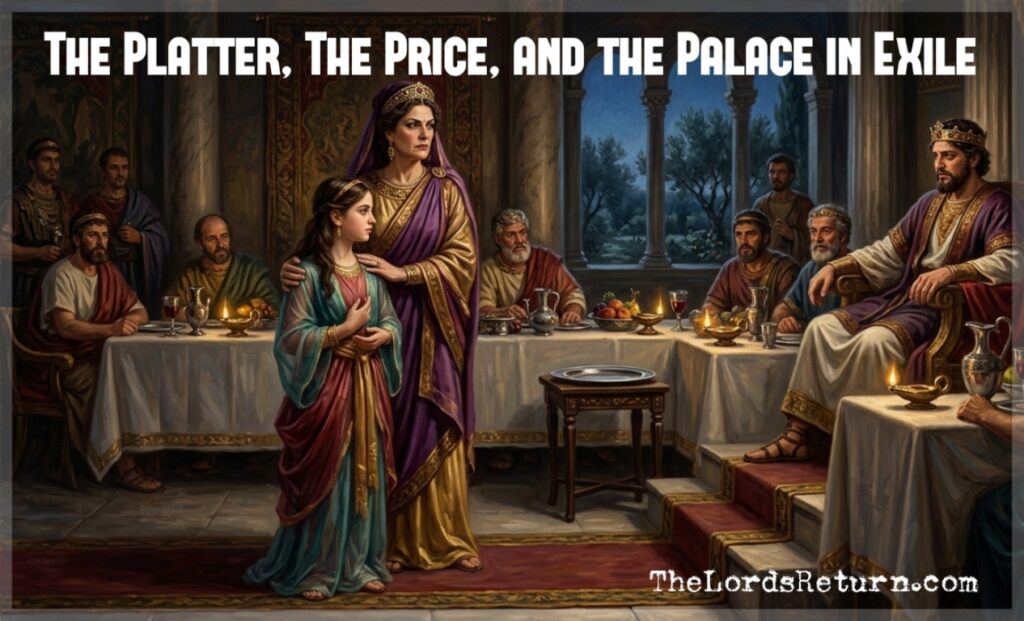
The record of the Herodian court is a testament to the bitter fruit of unbridled ambition. At the center of this moral collapse stood a marriage that defied the ancient boundaries of the Law, a union of convenience and corruption that brought the wrath of a prophet upon the halls of power. The tragedy of John the Baptist was not a random act of violence, but a calculated execution orchestrated by a woman who would stop at nothing to secure her standing: Herodias.
Herodias, a granddaughter of Herod the Great, was a woman whose life was defined by the relentless pursuit of royal status. Her union with her uncle, Herod Antipas, was a direct violation of the sanctity of the family bond established in the Torah. As the scripture records, John the Baptist boldly declared, “It is not lawful for thee to have thy brother’s wife” (Matthew 14:4, KJV). This was not merely a private moral failing; it was a public declaration that the Herodian dynasty considered itself exempt from the divine order. Herodias viewed this confrontation not as an invitation to repentance, but as a political threat to be silenced.
The culmination of this malice arrived at the birthday banquet of Herod Antipas. To manipulate the king, Herodias employed her own daughter, Salome. The young princess entered and danced before the king and his court, a performance that broke all bounds of royal dignity and decorum. Pleased by the spectacle, Herod swore an impulsive oath to grant her any request. Prompted by her mother, Salome made the ghastly demand: “Give me here John Baptist’s head in a charger” (Matthew 14:8, KJV). The deed was done, and the voice of the prophet was silenced by a platter of cold stone.
The dance was the hook, the king’s vanity was the line, and the death of the Baptist was the tragic result. Yet, the story does not end with the execution. The historical record, preserved by the historian Josephus, reveals that the crown Herodias fought so viciously to maintain was ultimately her undoing. Driven by an insatiable need for greater status, she urged her husband to petition the Roman Emperor for the title of King. Her ambition proved fatal to their power; accused of treason by her own brother, Agrippa I, the couple was stripped of their authority and banished by the Emperor.
The conclusion of the matter was not glory, but exile. Herodias and Antipas were sent to the remote provinces of Gaul, far from the opulence of their Galilean palace. While the world may offer temporary rewards for those who compromise the truth, the path of the wicked ends in emptiness. Herodias, who sacrificed a prophet to maintain a position of prestige, spent her final days in the cold obscurity of disgrace. She traded the eternal for the temporal, and in the end, she lost both. The silence that fell upon the banquet hall that night was but a precursor to the silence of her own forgotten exile.