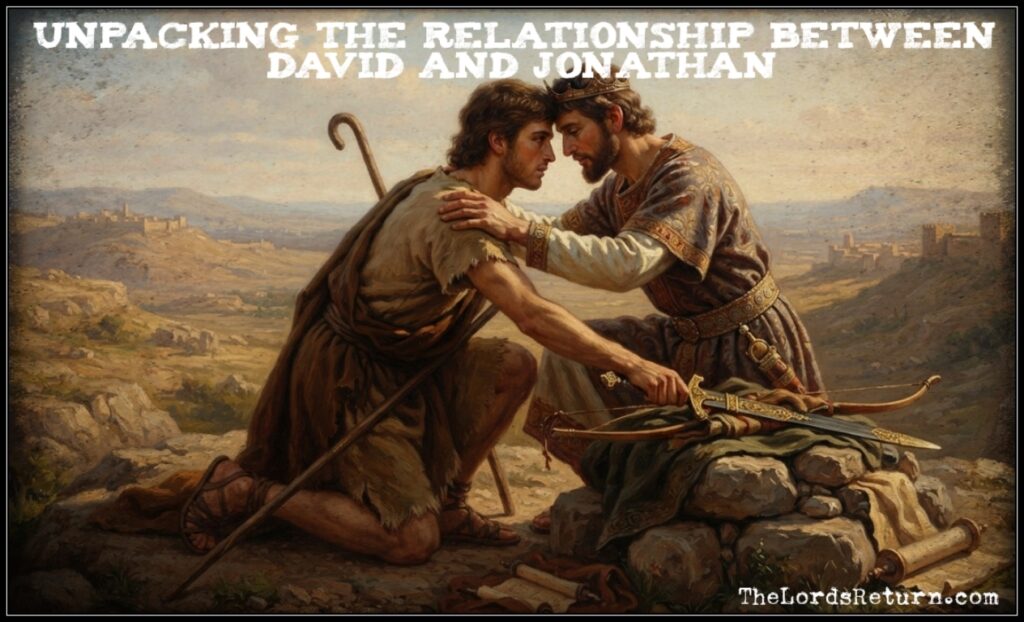
The nature of the relationship between David and Jonathan has been a subject of modern discussion, with some contemporary interpretations attempting to read modern romantic or sexual definitions into ancient Hebrew texts. However, a faithful examination of the scriptural record, ancient Near Eastern cultural contexts, and the precise definitions of the biblical language reveals a profoundly different reality: a sacred, covenantal brotherhood rooted entirely in mutual loyalty, political protection, and spiritual devotion under God.
The Language of Covenant and Kinship
To understand David and Jonathan, one must first understand the legal and cultural language of covenants in the ancient world. When 1 Samuel 18:1 states that “the soul of Jonathan was knit with the soul of David; and Jonathan loved him as his own soul,” it is employing established covenantal terminology.
In ancient times, political and personal alliances of supreme loyalty were framed in terms of familial love and soul-binding commitment. Jonathan was a prince, and David was an anointed shepherd boy marked for the throne. By cutting a covenant, they were binding their houses together.
Furthermore, scripture explicitly defines the nature of their physical demonstrations. When they parted or greeted one another, they wept and kissed, but these actions were standard cultural expressions of deep grief, respect, and farewell among men in the ancient Near East—much like the traditional greetings and farewells still practiced in many Middle Eastern and European cultures today. To impose modern Western sexual frameworks onto ancient Hebrew customs is anachronistic and obscures the true meaning of the text.
“Passing the Love of Women”
The most frequently cited verse by those attempting to redefine the relationship is David’s lament over fallen Jonathan in 2 Samuel 1:26 (KJV):
“I am distressed for thee, my brother Jonathan: very pleasant hast thou been unto me: thy love to me was wonderful, passing the love of women.”
To interpret this as romantic or sexual is to misread the literary genre and historical context of an elegy. David is mourning a bond of absolute, selfless loyalty. In the ancient world, familial bonds and strategic marriages were often fraught with political rivalry, division, and betrayal. By contrast, Jonathan—the rightful heir to the throne of Saul—surrendered his crown, his future, and his very life to protect David from his own father’s murderous wrath.
Jonathan loved David with a sacrificial fidelity that surpassed the natural alliances of blood or political convenience, risking everything to save David’s life. It was a love of supreme personal sacrifice, mirroring the kind of ultimate loyalty later described in John 15:13 (KJV):
“Greater love hath no man than this, that a man lay down his life for his friends.”
The biblical text leaves no room for moral ambiguity regarding the character of either man. Both David and Jonathan operated within the strict moral boundaries of the Mosaic Law.
- Jonathan’s Integrity: Jonathan was a man of unwavering faith, demonstrated when he boldly attacked a garrison of Philistines trusting wholly in the deliverance of the Lord (1 Samuel 14:6). His life was characterized by righteousness and obedience to God.
- David’s Heart: While David later stumbled gravely in his life regarding Bathsheba—a sin explicitly rebuked and judged by God in scripture—the narrative surrounding his youth and his relationship with Jonathan is marked by righteousness, honor, and mutual submission to God’s sovereign plan for the kingdom of Israel.
The relationship between David and Jonathan stands as the premier biblical example of godly friendship. It was a union of two souls dedicated to the same divine purpose, standing shoulder-to-shoulder against tyranny, and prioritizing God’s will above personal ambition or royal privilege.
The attempt to label David and Jonathan as anything other than brothers-in-arms and covenant partners collapses under the weight of historical context and textual integrity. Their bond was not built on earthly romance, but on a heavenly calling. It was a pure, fearless, and sacrificial friendship designed to preserve the Messianic line through the darkest days of Israel’s monarchy.