In the meticulous records of the King James Bible, certain names carry immense historical, geographical, and prophetic weight. The name Nebo—derived from a root meaning “to proclaim” or “prophesy”—does not refer to a single individual, but is shared across separate contexts. A forensic cross-examination of the scriptural text reveals that Nebo designates a famous mountain peak where an era ended, an ancient Reubenite city on the frontier, a post-exilic family line of returned exiles, and a prominent pagan deity whose structural collapse signaled the fall of an empire.
The Mountain of Vision and Departure
The most famous geographical placement of Nebo is the monumental mountain peak located in the land of Moab, directly opposite Jericho. Rising above the Jordan Valley, Mount Nebo served as the final staging ground for Moses at the conclusion of the forty-year wilderness trek.
Because of his structural disobedience at the waters of Meribah, Moses was forbidden from physically leading the congregation across the Jordan River. Instead, the Almighty commanded him to ascend this specific peak to view the inheritance of the tribes. The sacred text records this final, historic ascent with architectural precision:
“And Moses went up from the plains of Moab unto the mountain of Nebo, to the top of Pisgah, that is over against Jericho. And the LORD shewed him all the land of Gilead, unto Dan… And the LORD said unto him, This is the land which I sware unto Abraham, unto Isaac, and unto Jacob, saying, I will give it unto thy seed: I have caused thee to see it with thine eyes, but thou shalt not go over thither.” (Deuteronomy 34:1-4)
Upon this rugged summit, having executed his assignment and guarded the written law, Moses died according to the word of the Lord. The Creator buried his servant in a hidden valley nearby, ensuring his burial place remained unknown to prevent it from becoming a site of modern idolatry or superstitious worship.
The Frontier City and the Post-Exilic Line
In addition to the mountain, Nebo designates a prominent frontier town located nearby in the high pastoral plains east of the Jordan. Originally requested by the tribes of Reuben and Gad because the territory was excellent for cattle, the town of Nebo was fortified and renamed (Numbers 32:3, 38). Because of its highly volatile border position, this city frequently changed hands during geopolitical shifts, later falling back under Moabite control, as documented by both the prophet Isaiah and the famous Moabite Stone archaelogical artifact (Isaiah 15:2).
Centuries later, during the post-exilic restoration under Ezra and Nehemiah, Nebo reappears as an essential family registry. When the returned remnant traveled back from the Babylonian captivity to rebuild Jerusalem, the strict genealogical logs record the sons of this ancestral line standing fast to reclaim their inheritance: “The children of the other Nebo, fifty and two” (Nehemiah 7:33). Furthermore, several descendants of this family block executed physical obedience by aggressively purging foreign compromises from their households to protect the purity of the community (Ezra 10:43).
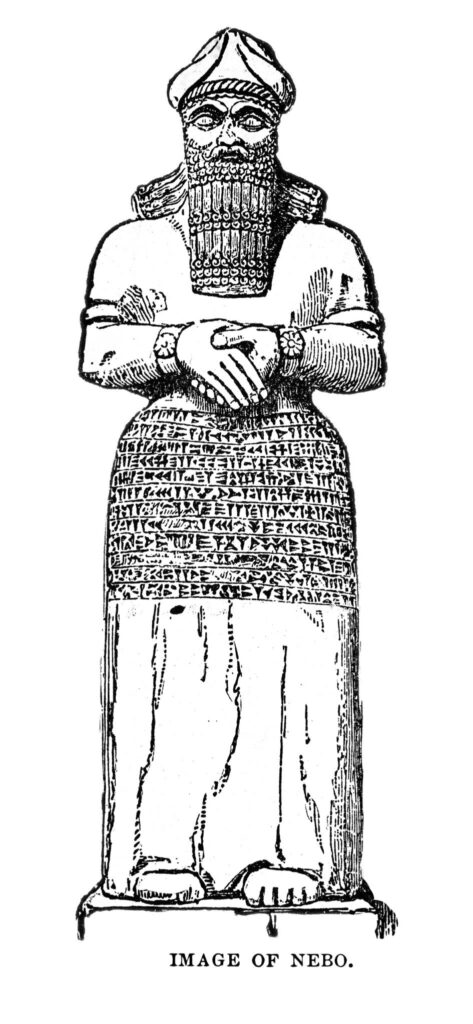
The Collapsing Idols of Babylon
The final and most sinister manifestation of Nebo appears in the prophetic tracking of false deities. In the ancient Babylonian pantheon, Nebo (also spelled Nabu) was the high-profile pagan god of wisdom, writing, literature, and science. He was revered as the son of Marduk, and his geopolitical prominence was so immense that his name was woven directly into the titles of elite imperial rulers, including Nebuchadnezzar, Nabopolassar, and Nebuzaradan.
During his profound prophetic watch concerning the structural collapse of the Babylonian Empire, the prophet Isaiah targeted this specific false deity to demonstrate the absolute supremacy of the Living God. Isaiah foretold the literal moment when these massive, gold-plated idols would be violently cast down from their temple pedestals, strapped to the backs of weary beasts of burden as a broken, captured remnant fled the invading Persian forces:
“Bel boweth down, Nebo stoopeth, their idols were upon the beasts, and upon the cattle: your carriages were heavy laden; they are a burden to the weary beast. They stoop, they bow down together; they could not deliver the burden, but themselves are gone into captivity.” (Isaiah 46:1-2)
While the pagan priests claimed that Nebo possessed the ultimate wisdom to secure the empire, the idol proved completely impotent, unable to protect its own structure or deliver its worshippers from ruin.
Whether looking at the mountain of vision where a legendary prophet finished his course, the family lines that returned to rebuild the broken walls of the realm, or the shattered statues of a fallen empire, the name Nebo stands as a firm testament to the uncompromised authority of God’s Word. It serves as an enduring reminder to the modern church that every mountain of trial provides a view of the promise, every faithful family line is meticulously recorded by the King, and every modern idol built by human hands will ultimately stoop and bow down before the sovereign majesty of the true God, for the King is at the door.