There is perhaps no verse in the modern theological lexicon so thoroughly hollowed out and weaponized for personal ambition as Paul’s declaration to the Philippians. Stitching it onto athletic gear, plastering it across corporate vision boards, and shouting it from the pulpits of the prosperity gospel, the culture has transformed a profound declaration of spiritual survival into a blank check for earthly success. The modern interpretation is as pervasive as it is flawed: “Whatever goal I set my mind to—whatever trophy I chase, whatever tax bracket I aim for—Christ is the engine that will get me there.”
But when the text is wrenched out of the hands of the self-help gurus and placed back into its historical and scriptural geography, the true meaning flips on its head. It is not a blueprint for personal triumph; it is a battle-tested doctrine of supernatural endurance.
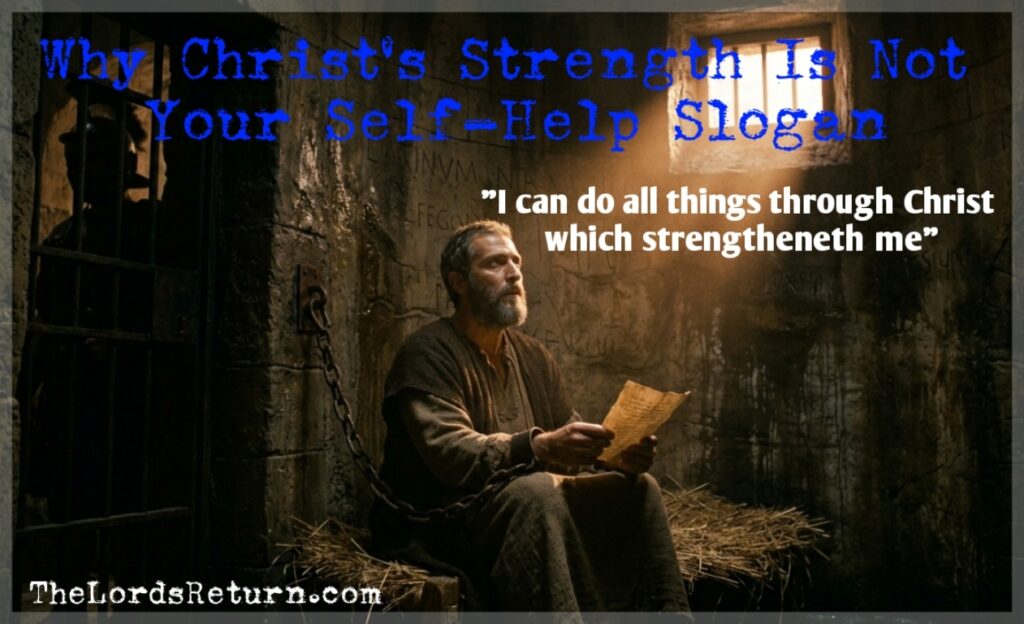
“I can do all things through Christ which strengtheneth me.” (Philippians 4:13)
To understand the mechanics of the “all things” Paul speaks of, one must first look at his immediate surroundings. Paul did not write these words while standing on a mountaintop of material victory, nor was he charting a path toward earthly comfort. He wrote them while sitting in chains, confined to a grim, damp Roman prison cell, staring directly into the face of state execution. He was not optimizing his potential or building a brand; he was explaining how he remained unbroken under the crushing weight of imperial persecution.
The true parameters of this strength are defined explicitly in the verses immediately preceding his famous declaration. Paul lays out his resume of hardship:
“Not that I speak in respect of want: for I have learned, in whatsoever state I am, therewith to be content. I know both how to be abased, and I know how to abound: every where and in all things I am instructed both to be full and to be hungry, both to abound and to suffer need.” (Philippians 4:11-12)
The “all things” of verse 13 are not worldly accomplishments, physical milestones, or financial breakthroughs. The “all things” are poverty, hunger, humiliation, and severe lack.
Paul is delivering a masterclass in holy fortitude. He is declaring: “I know what it is to have an empty stomach, and I know what it is to be slandered by the world. I know what it is to look at bare walls in the dark while shackled to a pagan guard. Yet, through every brutal extreme, I am entirely filled with a power that prevents me from murmuring, compromising, or denying my Master.”
The strength Christ infuses into the believer is not an optimization tool for human ambition; it is the power to remain completely unmoved inside the trial. It is a supernatural insulation that allows a man to suffer the loss of all things without losing his joy, his dignity, or his uncompromised mission.
When the culture turns entirely hostile, when standing for biblical truth costs a man his livelihood, his social standing, or his freedom, Philippians 4:13 is the anchor. It turns the modern, self-centered narrative completely upside down. The verse does not promise that Christ will serve our goals; it guarantees that Christ will sustain us while we serve His, no matter how fierce the storm becomes. It is the testimony of a remnant that stands fast, unbroken by the pressures of the age, knowing that the King is at the door.